
Voices behind UNIFIED: Esther and Jorien on Putting Patient Needs at the Centre of Healthcare Decision-Making

Updated: Nov 18, 2025
Why putting the needs of patients at the centre is crucial for decision-making in healthcare
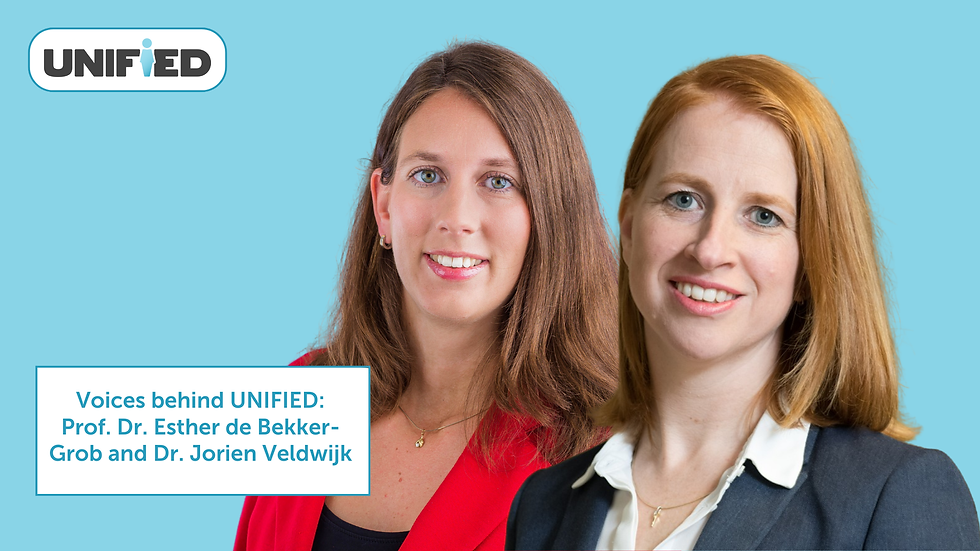
Prof. Dr. Esther de Bekker - Grob and Dr. Jorien Veldwijk are the public lead and (co-)coordinator of the UNIFIED project — a large public–private initiative worth €27 million and involving 40 partners across Europe, North America, and Canada. In this interview, they share their vision of patient-centred care and explain why it is vital to place patient needs at the heart of healthcare decision-making. They talk about the challenges they face in starting this project and offer a glimpse into what success looks like to them for the future of healthcare.
Why UNIFIED?
Why is it important to place the needs of patients at the centre of healthcare decision-making?
“Clinical trials often focus on outcomes that measure the safety and effectiveness of medical interventions. While these are critically important, they do not always reflect what patients genuinely value. When patient perspectives are not integrated into decisions around the development, approval, and reimbursement of medical interventions, the results are suboptimal care and inefficient use of resources. This can lead to reduced treatment adherence, less effective self-management, low acceptance of treatments, poorer health outcomes, and increased inequality within society. It can also contribute to wasted resources, rising healthcare costs, and more complications or hospital readmissions. By developing medical interventions that align with what patients need, we can improve health outcomes, reduce inefficiencies in care and product development, and ultimately lower the economic burden of chronic diseases.”
Personal motivation
What inspired you to initiate this project, and why now?
“Although the pharmaceutical and medical technology industries, as well as policymakers responsible for approval and reimbursement decisions, increasingly recognise the importance of patient perspectives, this recognition is not yet consistently translated into practice. Given the pressures on healthcare systems and the urgent need to align care with what patients require, now is the time to act. UNIFIED is able to address this need thanks to the availability of technological advancements such as Artificial Intelligence and telemedicine, increased policy support for patient involvement, cultural shifts within healthcare that place more focus on patient experience and communication, and new types of patient-centred data, including patient preferences, patient-reported outcomes, and digital health information.”
What do you hope to achieve?
What change do you aim to create with the UNIFIED project?
“With UNIFIED, we want treatments to truly match what patients need. For the pharmaceutical and medical technology industries, the project will make it easier to incorporate patient-centred goals into clinical research. Policymakers will be better equipped to make decisions about approving and reimbursing interventions that benefit patients most. Ultimately, we aim to improve patient-centred care by ensuring that decisions in healthcare genuinely reflect what patients value. In the long term, this will contribute to better outcomes for patients and greater economic sustainability of healthcare. Our goal is that by the end of the project, using patient-centred data will no longer be the exception but the norm.”
The challenge
What do you think will be the biggest challenge in truly elevating the patient voice in this project?
“In UNIFIED, we do not see amplifying the patient voice as a challenge, but as an opportunity that we actively embrace. Through a structured approach, we have created a strong foundation for meaningful patient involvement. Patient organisations and representatives are closely involved from start to finish, ensuring an inclusive and representative process. We collaborate with a Patient Advisory Group made up of both disease-specific and cross-disease patient organisations, whose input is systematically collected and integrated so that outcomes reflect patients’ real needs and expectations across and beyond Europe. Through tailored training, webinars, workshops, and co-creation activities, we facilitate dialogue between patients, researchers, and stakeholders, strengthen understanding, and secure ongoing participation. In this way, elevating the patient voice is not just achievable but an integral part of UNIFIED, enabling us to improve patient-centred care and create lasting impact.”
Looking ahead
What does success look like for UNIFIED? Where do you want to be in five years?
“Success means that five years from now, UNIFIED has truly made a difference in patient-centred care and innovation. Scientifically, we want a better understanding of how patient involvement, clinical outcomes, and digital monitoring intersect, and clarity about which patient-centred data matters most in clinical research. Economically, success means that developing new medical interventions becomes faster and more efficient, and collaborations between researchers, industry, and patients operate seamlessly. Socially, it means that patients have more influence over development, approval, and reimbursement decisions, that their wellbeing and satisfaction visibly improve, and that policymakers can make better, data-driven decisions. Ultimately, treatments will better match patient needs, care will become more effective and personalised, innovation will accelerate, and the framework and recommendations developed by UNIFIED will be embedded into existing healthcare systems. In short, we want UNIFIED to become the standard for patient-centred care, creating real value for patients, researchers, and the entire healthcare sector.”


